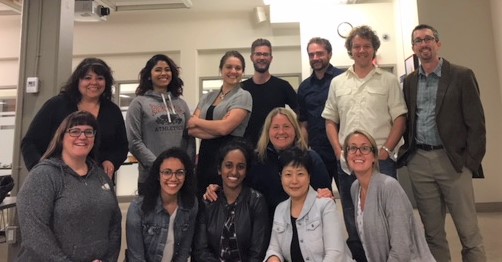
This past year I’ve had the great privilege of working with Stanley Hauerwas on his forthcoming book Minding the Web: Making Theological Connections (Cascade Books). I served as something of a curator and editor of Hauerwas’s essays, addresses, and sermons, as well as contributing a couple of essays and sermons of my own to the volume. The essays, I believe, feature some of best writing, so I am delighted that they have found a home in such a rich volume alongside of Hauerwas’s enduringly relevant and provocative investigations and sermons. In addition to the gracious invitation to participate in the project, Stanley has generously granted me permission to share some of my favourite quotes from the book in the days leading up to its publication. Over the course of the next few weeks, I will draw attention to some of the turns-of-phrase, sentences and short passages that, for one reason or another, captured my imagination. (more…)
Tag: theology
-
Reading with the Fathers
For many years now I’ve been waiting for the opportunity to teach a course on the Church Fathers. In January, the day will finally arrive. I’ve recently finished drafting my syllabus for the course I’ll be offering in the winter term entitled: “Theologians of the Church: Reading with the Fathers.” The course will consist of a combination of lectures and seminars around primary readings from the Fathers. You can read the course description below. As there are many students who come from Mennonite and evangelical traditions where the Church Fathers are either ignored or perhaps even looked upon with suspicion, it seemed important to cast the description in an apologetic key. (more…)
-
The Spirit of Early Christian Thought
I’m in the midst of reviewing some resources for a course I’m going to be offering on the Church Fathers in the winter and came across this quote from the introduction to Robert Wilken’s wonderful book The Spirit of Early Christian Thought that resonates with Robyn’s and Don’s comments on my previous post: (more…)
-
The End of an Era
I recently wrapped up my final course at Tyndale Seminary. It was nice to have a smaller group (pictured above) for this last time through Systematic Theology I. (more…)
-
Series: Newbigin on “The Call to the Church” – 3. A Declericalized Theology
[This post is the fourth in a series of posts on what could be called “Newbigin’s marks of the missional church” as outlined in his book Foolishness to the Greeks. The previous posts can be found here: introduction, mark #1, mark #2.]
“The missionary encounter with our culture for which I am pleading,” Newbigin writes, “will require the energetic fostering of a declericalized, lay theology.”[1. Lesslie Newbigin, Foolishness to the Greeks: The Gospel and Western Culture (W.B. Eerdmans: Grand Rapids, 142.] Upon returning to England after years of missionary service in India, Newbigin observed that theology in the modern West had become largely isolated from the lives and concerns of average Christian men and women. (more…)
-
Bonhoeffer on the Danger of Theology
In the winter of 1936, Dietrich Bonhoeffer delivered a series of lectures on the theme of pastoral care to the seminarians under his direction at the underground seminary at Finkenwalde. Bonhoeffer concluded this course of lectures by reflecting on the need for pastoral care for pastoral counselors. Interestingly, Bonhoeffer suggests that “another source of trouble for the serious pastor is his own theology” (Dietrich Bonhoeffer, Dietrich Bonhoeffer Works, vol. 14, ed. H.G. Barker and M.S. Brocker (Minneapolis: Fortress Press, 2013), 590). (more…)
-
Beginning in the Middle

Theological reflection always begins in the middle. After all, theological reflection is the work of a people who find themselves on pilgrimage (in via) as a result of being claimed by the address of the Triune God. There is no getting back to square one – to some primal location – for we are historical creatures who cannot escape our positioning in a good, but fallen world that started long before we arrived and, God willing, continue for long after we’ve died. Furthermore, if God is truly God, then God is not simply there to be discovered like helium or hydrogen, mites or mandrills. If theological reflection is to be truly theological it can only be, as Karl Barth famously maintained, a “thinking after” (Nachdenken in German) the reality of God’s self-revelation in the person of Christ. (more…)