A short quote from Stanley Hauerwas’s Fully Alive: The Apocalyptic Humanism of Karl Barth (University of Virginia Press, 2022):
(more…)Author: rjdean76
-
The Devil, the Spirit, and the In-Between
I came across a fascinating quote from Joseph Ratzinger/Pope Benedict XVI in an essay entitled, “Farewell to the Devil?” It also reminded me that I had intended to draw attention to Phil Ziegler’s recent Warfield Lectures at Princeton, entitled, “God’s Adversary and Ours: A Brief Theology of the Devil.” The whole series of lectures can be viewed here:
(more…)
2024 Warfield Lectures: Satan—A Motivational Talk (youtube.com) I share a longstanding interest in apocalyptic eschatology with Dr. Ziegler and I was fortunate to have him as a member of my dissertation examination committee back when I was a doctoral student. -
New Issue of Didaskalia!
I am pleased to announce the publication of Volume 31 of Didaskalia on the theme “Engaging Scripture.” The issue features an impressive collection of peer-reviewed essays, intriguing reflections from the front lines of ministry, edifying sermons, and reviews of some of the lastest books of note. You can view the full table of contents here. As part of our continuing commitment to providing accessible theological scholarship in service of the church, we are continuing with the special promotional offer of making the issue available for the cost of postage. You can subscribe for the latest issue here. In the video below, my colleague Joshua Coutts talks about his essay from the volume, “Formed by the Word in an Age of Information.”
(more…) -
The Anxious Generation
I recently read Jonathan Haidt’s book The Anxious Generation: How the Great Rewiring of Childhood Is Causing an Epidemic of Mental Illness. Haidt is a social psychologist who teaches at New York University’s Stern School of Business. Two of his notable previous books are The Righteous Mind and The Coddling of the American Mind. I have followed some of his work on his Substack After Babel.
(more…) -
Video Lecture: “Imagining a Better Way”
The video recording of my recent BTS Symposium presentation, “Imagining a Better Way: Towards a Theology of Transformative Preaching,” is now available on the Providence YouTube channel. There was a great turnout for the event with a capacity crowd in the room and a good group joining online. There were some insightful questions from both the in-person and online attenders.
-
Still Time to Register
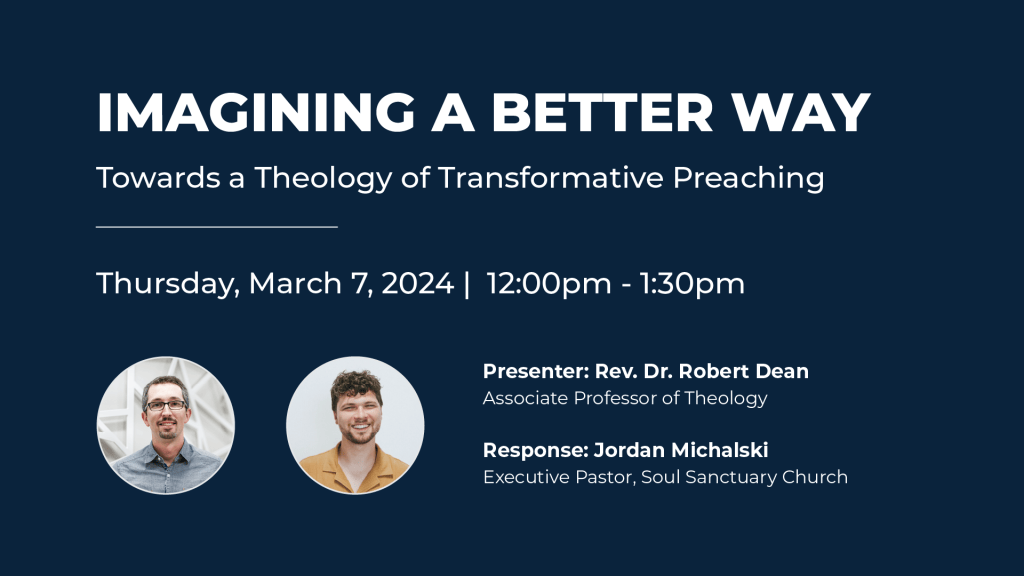
There is still time to register for next week’s Symposium presented by the Biblical and Theological studies department of Providence Theological Seminary featuring my presentation “Imagining a Better Way: Towards a Theology of Transformative Preaching.” I’ve been told that there has been a great response so far and that we are quickly approaching the room capacity. (It’s amazing what a free lunch can do!) However, there is no limit to the number of people who can join on Zoom. To register, visit:
Seminary Symposium – Providence University College and Theological Seminary -
Lent follows Swift-piphany
The following paragraphs contain the rather whimsical observations with which I began my sermon this past Sunday for the first season of Lent at Grace Bible Church in Winnipeg. They set the stage for my reading of Mark 1:1-15 as the interpretive key for Mark’s Gospel and for the church’s pilgrimage through the season of Lent.
(more…) -
Atonement and the Ordinary
Last year, I read Julie Canlis’ wonderful, little book A Theology of the Ordinary (2d, ed.;Godspeed Press, 2018). The book emerged from the author’s “extended meditation on this cultural obsession with greatness and being ‘impactful’” (2). Canlis ponders whether “our culture’s emphasis on supercharged emotions and measurable success blinded us to Romans 12 and the fact that our ordinary lives are our ‘spiritual act of worship’” (3)? In the rest of the book she precedes to sketch out a brief “theology of the ordinary” organized around the themes of creation, redemption, and new creation.
(more…) -
On Pilgrimage
A short quote from Jim Forest’s devotional book, Pilgrimage as a Way of Life (Maryknoll: Orbis, 2007):
“You can walk to some great shrine on a journey that takes weeks or months and fail to become a pilgrim. Walking a pilgrimage route, wearing a pilgrim’s badge, and sleeping in pilgrim’s hostels, are not what make a pilgrim. Pilgrimage is more an attitude than an act.[1. I would be inclined to say that pilgrimage involves both the activity and the disposition.] If all you are seeking is exercise, diversion, or a deed that will slim your body or impress your friends, you might be happier racking up miles on an exercise cycle at the local gym. Pilgrimage is a conscious act of seeking a more vital awareness of God’s living presence. As was said in medieval times, ‘If you do not travel with the King whom you seek, you will not find him at the end of your journey.’”

